Smart Speaker Privacy

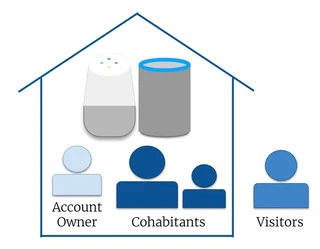
Smart speakers interact with anyone that is near them with no regard for who is the account owner, who has signed the terms of service agreement, or who’s account is being interacted with. Newer controls do allow linking some actions to specific voice profiles, but fundamentally smart speakers are designed to interact with anyone who speaks to them. Such authentication-minimal interaction can have some problematic side-effects for nearby bystanders who may not even know that there is a smart speaker in the room, much less have had an opportunity to read the terms of service or see what the settings are.
This research project looks into the privacy concerns of smart speaker account owners, co-habitants who regularly interact with the speaker, and bystanders who may be visiting a space for the first time. Through a sequence of studies we explore the different privacy concerns of these groups and how we might best support them. We also build a taxonomy of such concerns which should enable other researchers to explore the space of privacy-problematic smart speaker interactions in a more structured and comparable way.
People
- Nicole Meng
- Adam Jenkins
- Maria K. Wolters
- Kami Vaniea
