Faheem: Explaining URLs to people using a Slack bot
Apr 1, 2018· ,·
0 min read
Kholoud Althobaiti
Kami Vaniea
Serena Zheng
Abstract
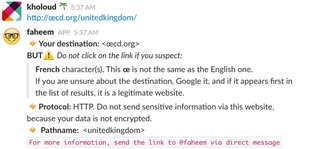
Online safety regularly depends on users’ ability to know either where a URL is likely to lead or identify when they are on a site other than they expect. Unfortunately, the combination of low URL reading ability in the general population and the use of hard-to-detect approaches like look-alike letters makes the reading of URLs quite challenging for people. We design a Slack bot, named Faheem, which assists users in identifying potentially fraudulent URLs while also teaching them about URL reading and common malicious tactics. In this work, we describe the design of the bot and provide an initial evaluation. We find that Faheem does a good job of interactively helping users identify issues with URLs, but Faheem users show minimal retention of knowledge when they lose access to the tool.
Type
Publication
In Symposium on Digital Behaviour Intervention for Cyber Security

Authors
Kami Vaniea
(she/her)
Associate Professor
I am an Associate Professor at the University of Waterloo’s Department of Electrical and Computer Engineering (ECE) where I head the Technology Usability Lab in Privacy and Security (TULiPS). The goal of my research is to make security and privacy technologies more accessible for a wide range of users including end users, developers, and system administrators. I believe that technology should support people in their activities. My recent projects include topics like patch management, developer-centered privacy, phishing, online anonymity, smart speaker privacy, and privacy on social media.